|
 1 The Dao of Acupressure and Acupuncture:
If one comprehends the process of healing
as becoming whole again, it is clear that this process occurs
largely as a result of coincidence – a fortuitous combination
of the various aspects and dimensions of human existence.
As a healer and doctor, you soon become aware of how much
you do not understand of the complexity of life. Before attaining
this insight, however, you perhaps only vaguely sense, every
now and then, that healing also depends to a great extent
on something inexpressible and numinous.
The more primary a healing system is, the more its methods
involve the presence of the numinous. The Chinese call it
the Dao: "the nameless" or "the way."
In former times, the more aboriginal a medical system was,
the more numerous were the duties which a healer had to fulfill
in order to meet the demands of a little specialized and less
civilized world.
The care and treatment of the ill was not the main concern
of the barefoot doctors in ancient China. Their main duty
was preventive medicine. If they gave bad counsel or began
treatment only after the person was already ill, their payment
was withheld. In some cases the healers were even cursed at
and shamed out of the village. It is understandable, therefore,
that they had the greatest possible interest in the well-being
of their patients.
In this manner, as early as two to three thousand years ago,
a medical system was developed which included all areas of
healing, from nutrition to prayer and meditation, from psychiatry
to internal medicine. Traditional Chinese medicine was and
still is holistic medicine in the purest sense of the word,
because the Chinese world view does not know a separation
of body and soul and therefore always treats physical, emotional
and mental symptoms together – as symptoms of a disturbed
equilibrium of the elemental forces at work within us.
1.1 The seven steps of healing
Traditional Daoist medicine distinguishes
between seven levels of healing, each of descending levels
of importance. The spirit plays a superior role. Religiousness,
in the sense of the Latin word "religio," which means connection
to the root or to the origin, was viewed as the highest
and most important level
of Daoist healing. One of the most important tasks of the
healer was and is to help the patient find a way to his or
her inner world, to find an access to religiousness and spirituality
which includes knowledge of the meaning of life, illness and
death. In almost all primitive cultures the medicine man or
shaman has this function.
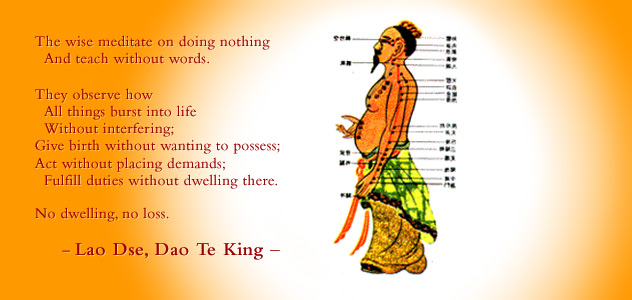
In the language of Daoism this level is called the contemplation
of the Dao. Meditation is the tool that provides insight into
the nature of the Dao.
The completion of an inner or outer ritual is not essential
for meditation in the Daoist sense. Here, meditation means
opening yourself to life in all its apparent contradictions,
flowing with the continually changing, pleasant or unpleasant
events in life. Someone who meditates in the Daoist sense
does not use mantras or prayers to attain an ideal state which
differs from the reality of everyday life. Daoist meditation
does not mean striving toward a valium-like state of piety.
Meditation is not the exclusion of the world or your own personality
conflicts in order to attain an illusion of wholeness, peace
and harmony.
Immersion in the Daoist sense means diving into things as
they are, without wanting to change them, without resistance
to what they are. This, however, does not mean that you are
released from your social and political responsibilities.
Meditation means learning to act without losing yourself in
these actions.
In contrast to the Daoist view, Western medicine separates
religiousness and spirituality from the natural sciences.
The intensive care units of our hospitals are an excellent
example of how high-tech medicine tries, in some cases almost
cruelly, to "swim against the current of life and death" and
to force healing under any circumstances – without consideration
for human dignity and integrity. Following the Dao, however,
means surrendering to the flow of things which are larger
than yourself and wiser than your reasoning.
Following the Dao means diving into
the stream in which healing can happen – or also not happen,
in which the non-healing of the body can lead to the healing
of the soul. Following the Dao means trusting your inner voice,
letting go of the desire to rationally understand every detail
of life and, thus, relinquishing constant control.
The second
level of Daoist healing is
conscious breathing. Breathing links the different
levels of existence within us, even if we are not aware of
it. It not only keeps us physically alive, but is also a constituent
of the way we think and feel. The various feelings, emotions,
mental states and behavioural patterns can only exist in connection
with corresponding respiratory patterns: with a particular
quality, a specific rhythm, a specific depth and a particular
frequency. Try to be hysterically anxious, while inhaling
and exhaling slowly and deeply through your open mouth. It
will not work. As thoughts and feelings are so closely linked
to our breathing, it is natural to conclude that by changing
our respiratory pattern we can influence our feelings and
thoughts. Thus we can utilize the relationship between emotions
and breathing either to bring frantic and extreme thoughts
and feelings under control, or, on the other hand, to release
emotions which have long been suppressed which now cause weariness,
depression and various diseases. This is significant, as traditional
Chinese medicine is essentially psychosomatic – the Chinese
do not recognize a cleavage between body and soul. In Chinese
medicine the treatment of a physical disease generally includes
some psychological counseling or advice, because, as I mentioned
before, the Daoist world view considers physical, emotional
and mental symptoms and illnesses as originating from the
same source, namely a disturbed equilibrium of the elemental
forces. Therefore, to really understand Chinese medicine,
you need to grasp the theory of the Five Elements.
The teaching of the Five Elements distinguishes between five
major emotions which need to be more or less equal in strength
to form a healthy and vital personality. If these five major
emotional forces are balanced within us, the immune system
will be healthy and body and soul will be in harmony.
The five major emotions of the elements are:
| The element
WOOD |
- self-assertiveness and anger |
|
|
| The element FIRE |
- joy and love |
|
|
| The element EARTH |
- sympathy and concern |
|
|
| The element METAL |
- withdrawal and grief |
|
|
| The element WATER |
- fear, awe and sexuality |
The teaching of the Five Elements also
names the organs and tissues which become chronically damaged
and eventally sicken as a result of the weakening or repression
of a major emotion.
Daoist medicine views the five emotions as elemental forces
which are equally important for our health and well-being. This
makes Chinese medicine a revolutionary method for us because
our culture only acknowledges "positive" feelings
and impulses; feelings like empathy, gentleness, love and romance
are highly respected and idealized, whereas, already as children,
we have been taught not to cry or to be afraid and that anger
and sex are basically bad. As Western culture attributes very
different values to the five major emotions, many forms of suffering,
neuroses and illnesses are continually being created. The moral
condemnation of anger, for example has led to an exaggeration
of the Wood element in our culture. It has created military
super powers, criminal violence and the pervasiveness of blood
and murder on TV. The moral condemnation of sex also caused
the opposite: an obsession with sex in the mass media and marketing
and a flourishing porno industry.
The third
level of healing is movement.
Inner movement means the movement of Qi – the Chinese term
for life force – in the meridians through breathing and imagination.
Outer movement stimulates the energy flow in the body as well.
Tai Ji, Aikido, Kung Fu and related martial arts are important
in the prevention of illnesses which result from lack of movement,
being overweight and a weak or impeded energy flow.
The fourth level of healing
is proper nutrition. In
the Daoist sense this means nourishment according to the laws
of the Five Elements. The individual nutrients and spices
are distinguished according to which element – in addition
to a general Yin or Yang effect – they tend to empower or
subdue. Included in this level are the internal and external
application of herbal extracts and essences and, more recently,
the application of allopathic medicines, which often combine
well with Daoist medical procedures.
The fifth level consists
of massage and the use of baths.
For a Chinese doctor it is clear that with meridian massage
and acupressure the flow of Qi along the various energy channels
of the organism can be stimulated more effectively than with
acupuncture. The reason for this is that acupressure, meridian
massage, Shiatsu, and various forms of deep body work such
as Postural Integration and Rolfing, increase the tissue’s
permeability for Qi and can thus balance Emptiness and Fullness
along the individual meridians. Only when the flow of Qi along
the meridians is sufficient can it be effectively directed
and targeted with an acupuncture needle.
The sixth
level of healing consists of "pricking
and burning": acupuncture and moxibustion – the
burning of dried mugwort leaves (artemisia vulgaris) on acupuncture
points. Moxibustion is mostly used to tonify in the case of
energy deficiencies in specific organs or in the organism
as a whole. It is preferably applied in cold regions and in
winter.
The seventh level is surgery.
The seven levels of healing provide
insight into the multitude and variety of methods in traditional
Chinese medicine. They are also an aid for orienting yourself
in the evaluation of Chinese health techniques and healing
methods now available in the West. Just as Daoism in China
has included many things throughout the centuries, from the
philosophy of Lao Dse and Chuang Dse to superstitions and
folklore, contemporary Chinese medicine in the West also offers
gems, semi-precious stones and glass.
This is no different in China today.
The magic potion of Daoist thinking was more or less lost
during the Cultural Revolution when the practice of traditional
Chinese medicine became "modernized," that is, oriented toward
Western scientific methods. At this time, Chinese medicine
became just as mechanical and symptom-oriented as Western
medical practices. Meditation and traditional treatment according
to the teaching of the Five Elements were largely dropped,
while acupuncture by prescription was kept. As a result, the
spiritual meanings of the acupuncture points which are easily
recognizable in their ancient names – for example, "Altar
of the Spirit," "Gate of Divine Consciousness," "Reception
of Light" or "Heavenly Pond" have, at best, become a mythical
curiosity and barely have an influence on the general practice
of acupuncture.
In China today a timid restoration of the teaching of the
Five Elements and holistic medicine has begun, but the reason
seems to be more economical than metaphysical: the Chinese
have learned that Westerners hunger for metaphysical concepts
in medicine. As good tradesmen they include it in their offer
and sell it well. Still it can be assumed that traditional
Chinese medicine in the Daoist sense – except in Taiwan –
is most likely to be found in England, Holland, California,
New Mexico, Hawaii and Australia: in countries which were
influenced by Chinese culture long before Mao came to power,
and where the freedom of thought and science could lead to
further developments of Chinese medical methods, to a blend
with various valuable Western therapeutical concepts and to
a clearing-out of ancient superstitions. As a general rule
it can be stated that the majority of good schools of Chinese
medicine are located in these countries. These states also
have legislation which permits acupuncture to exist as an
autonomous medical practice, and not just as an additional
method when allopathic medical procedures fail.
2 Organs and Meridians:
A characteristic of the nature of Daoism
is the fundamental unity and interconnectedness of all things.
The various phenomena, structures and events of the organic
and anorganic world – geological and weather changes, cosmic
influences, plants, animals and people, as well as thoughts,
feelings and illnesses – are not viewed in isolation from
one another, but always as interwoven with things and happenings
in their immediate environment, and, ultimately, as mutually
dependent on everything else which exists.s
Organs and tissues, whether healthy
or ill, can also be understood in this way. The inner organs
are considered as functional units or functional spheres encompassing
and connecting the physical, emotional and mental realms of
the organism. The anatomical form of an organ is not really
important; the dynamic of its function and the dynamics of
its relationship to the other organs take precedence.
In
the Chinese view, each organ has, in addition to its physiological
task, emotional, mental and spiritual functions: it creates
certain emotions and feelings – and shapes and transforms
some of them as well. Sometimes, the emotions that are created
by one particular organ limit or repress the emotional expression
of another organ. In the mental realm, each organ produces
a certain way of thinking, an organ-specific kind of perception
and cognition which in turn interacts with the intellectual
capacities and mental skills of the other organs.
An
organ is viewed as a delicate network of energy flows running
through the entire organism – an interplay of bioelectro-magnetic
frequencies and the various forms of Qi which circulate in
the body. An organ represents a force field – its pole of
maximum density is the anatomical structure of the organ itself.
The energetic powerlines of the organ force field consist
of countless branches and ramifications – just like the ribs
in the stem of a leaf. Many of them directly flow into the
anatomical form of the organ. The energetic artery of the
organ is its corresponding meridian which leads the Qi of
the organ to the surface of the body, connecting it at some
points with the energy flows of other organs and meridians
... more
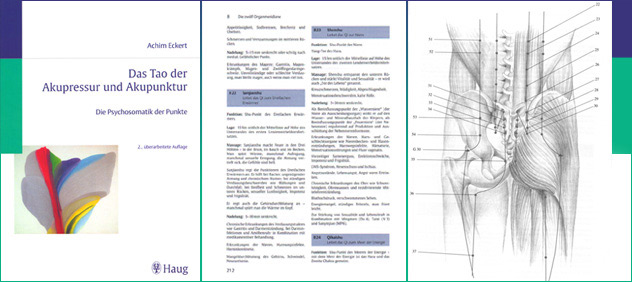
to read in the Book " Das Tao der Akupressur und Akupunktur"
3 The Twelve Organ Meridians:
3.1 The Lung Meridian:
The Lung Meridian is the Yin meridian of Metal.
| Coupled
Yin organ: |
Large
Intestine |
|
Odor during illness:
|
foul, fishy |
|
|
|
|
|
| Tissue: |
skin |
|
Facial colour during illness:
|
pale |
|
|
|
|
|
| Expression of power:
|
body hair |
|
Behaviour under stress: |
refusal, cough |
|
|
|
|
|
| Sensory organ: |
nose |
|
Feelings originating in the lung:
|
sadness, worry, loneliness,
coldness and cruelty, resignation, despairdepression,
hopelessness |
|
|
|
|
|
| Sense: |
smell |
|
The climate that enhances vitality
when the lungs are lacking Qi and that causes illness
when the lungs
are full with Qi: |
dryness |
|
|
|
|
|
| Bodily fluid: |
mucus |
|
Season: autumn |
exchange and rhythm |
|
|
|
|
|
| Timbre of voice:
|
metallic, nasal |
|
Direction of elemental power:
|
|
3.1.1 Internal course:
The deep branch of the Lung Meridian originates in the solar
plexus, the center of the Middle Warmer. It runs downward
and winds around the colon transversum. From there it flows
upward again, reaches the stomach and transverses the diaphragm
through the hiatus oesophageus. Above the diaphragm it splits
into two branches, one for the left and one for the right
lung. These exit the lungs through the two main bronchia and
unite again in the trachea.
The deep branch flows upward to the larynx, splits anew, and
both energy channels lead the Qi diagonally downward to the
shoulders where the Lung Meridian surfaces in the frontal
shoulder furrow, in the connective tissue between the pectoralis
major and the deltoid muscles.
3.1.2 External
course:
The first section of the Lung Meridian flows in the
frontal shoulder furrow upward until just before the collar
bone (Lu 2). Here the meridian turns outward, leads diagonally
across the front of the deltoid and, on the upper arm, along
the outer side of the biceps (Lu 3, Lu 4).
In the elbow it runs radially to the biceps tendon (Lu 5),
in the forearm along the M. brachioradialis which it then
traverses to run, parallel with the nervus radialis, the radial
artery and the radial veins, in the furrow on the radial side
of the M. flexor carpi radialis tendon, to the wrist. From
there the Lung Meridian flows across the palm to the thumb
where it ends at the radial corner of the nail.
3.1.3 Massage
and acupuncture:
The Lung is the organ which maintains the connection
with the external world. With each breath, we take in oxygen
and Qi and release carbon dioxide and Qi. The lungs transfer
"Qi of the Sky" to the Middle Warmer, where along with "Qi
of the earth" (nutrition) it unites with various forms of
energy which circulate through the body.
Acupuncture of the Lung Meridian helps a person when their
contact and exchange with their environment is curtailed or
disturbed. This type of dysfunction often leads to excessive
worry and a pessimistic attitude towards life, it brings melancholy,
sadness and a multitude of disappointments. In its chronic
form, it leads to resignation and depression on the one hand,
but also to loneliness and isolation, a feeling of being cut
off, without access to other human beings.
Within the spiritual realm, an impairment
of the Lung Meridian’s function can lead to religious puritanism,
rigid moral views and intolerant fanaticism.
Physiologically, a dysfunction of the lungs can lead to asthma
bronchiale, bronchitis, cough, inflammation and infections
of the nose and pharynx and other illnesses of the respiratory
system. Furthermore, weak lungs may lead to acute and chronic
skin diseases, such as acne and psoriasis, to disturbances
in the course of the meridian, such as muscle and joint pains,
paraesthesias and neuralgias, and to arthritis of the shoulder,
elbow and wrist.
Massaging the Lung Meridian enhances and deepens our breathing,
thereby stimulating a sense of optimism and courage. It relieves
sadness and worry, as well as cough and bronchitis. The respiratory
volume is increased, more oxygen and Qi are absorbed, and
our general level of energy is increased.
Deep breathing facilitates many physiological processes which
would otherwise remain problematic or incomplete, for example
the excretion of waste material. Furthermore, the necessary
level of Qi provided by deep breathing aids the perception
and expression of many feelings. The degree of vital energy
depends to a great extent on our breathing and the function
of the Lung Meridian. Thus, massage brings a breath of fresh
air to our emotional, spiritual and mental well-being: clarity,
order and new ideas.
Sometimes during massage or acupuncture of the Lung Meridian
you hear a rumbling or gurgling in the belly. This indicates
that the Qi in the deep branch of the Lung Meridian has started
to flow and stimulates the peristalsis of the large intestine,
thus relaxing the abdomen.
3.1.4 Directory
of points:
Times of maximum energy flow through the Lung Meridian
(best response for acupressure;
best time for sedation: 3-5 AM and 3-5 PM; best time
for tonification: 5-7 AM and 5-7 PM)
>>
Lu 1 Zhongfu | Office of
the Center
Function: Mu point of the lung.
Crossing point with the Spleen Meridian.
Site: In the furrow between the shoulder and the frontal
chest wall, 6 cun to the side of the middle line, at the same
level with Yuzhong (N 26) – N 26 lies in the first intercostal
space next to the breastbone.
Massage: Press deeply with the thumb, let the client
breathe deeply through a slightly open mouth.
Zhongfu opens the sluice – it facilitates the entrance of
Qi from the solar plexus and the Liver Meridian into the Lung
Meridian. Zhongfu gives confidence. You feel strength in the
lungs, power in the chest and arms. The feelings you experience
with Zhongfu can have a Yin or Yang quality.
The Yang quality: you feel large, strong, invulnerable,
filled with energy, power and the force to strike.
The Yin quality: you feel calm and self-assured, safe
and secure. You feel at home in your environment – the lung
connects you to the world. Shoulder ache, cough, shallow breathing,
depression.
Needling: Dangerous point. 5-10mm obliquely, in lateral
direction, in order to avoid damaging the pleura and causing
a pneumothorax.
All lung diseases such as bronchitis, asthma bronchiale, bronchiektasies,
tuberculosis and their accompanying symptoms such as cough,
shortness of breath, thorax pains and night sweats. Painful
and itching skin, chronic skin diseases.
Depression (if caused by or associated with shallow breathing),
feelings of hopelessness (as long as they are not based on
real situations, for example terminal cancer or imprisonment
and torture under dictatorial political regimes), worry, sadness,
and despair.
>>
Lu2 Yunmen | Gate to
the Clouds
Site: At the upper end of the frontal shoulder furrow
in the gap between the origins of the pectoralis and the deltoid
muscle under the collar bone, about 5,5 cun to the side of
the middle line.
Massage: Press deeply with the thumb, let the client
breathe deeply into the lungs through a slightly open mouth.
Yunmen enhances the Yin: you feel relaxed, adrift,
as in a reverie. All that is superfluous and unnecessary melts
away, you retreat into yourself. You are able to feel sure
of your strength. From this sense of security you develop
a feeling of peaceful self-confidence which enables you relate
to otherscomfortably and easily.
The image: "a moonbowl filled with fluid in a dark
room."
Yunmen sometimes stimulates reflection about the day gone
by. You may be inclined to rearrange past events in your mind,
as you wish them to have happened. Like other lung points
it sharpens the eye for the essential.
Shoulder pains, cough, shallow breathing, depression.
Needling: like Zhongfu (Lu 1).
>>
Lu 3 Tianfu | Palace of the
Sky
Function: Window to the Sky.
Crossing point with the Spleen Meridian.
Site: On the outer side of the biceps, 3 cun under
the end of the anterior axillary fold, or 6 cun above the
elbow. If you move the lateral rim of the biceps to the tip
of the nose you touch Tianfu.
Massage: Tianfu gives long-lasting strength and endurance,
and it expands the chest cavity. You may get a sense of having
large, powerful hands.
As Window to the Sky it relaxes the spirit, the head becomes
pleasantly dark and empty. Hiccoughs, upper arm pains, shallow
breathing.
Needling: 5-10mm perpendicularly.
Difficult breathing with a feeling of fullness in the chest,
asthma bronchiale, rheumatic shoulder pains.
>>
Lu 4 Xiabai | Gallant White
which Loves Justice
Site: On the outer side of the biceps, 4 cun under
the end of the anterior axillary fold, 1 cun under Lu 3.
Massage: Xiabai strengthens the lungs and the energy
field in front of the chest. It relaxes the back of the shoulders
as well as the legs. You feel relaxed and well, sheltered
and secure. Cough, upper arm pains.
Needling: 5-20 mm perpendicularly.
Chest pains, shortness of breath, lung diseases.
>>
Lu 6 Kongzui | Distinct Cavity
Hole of Greatest Effect
Function: Xi point
Site: On the inner side of the forearm, on the M. brachioradialis,
7 cun proximal to the wrist crease, on a straight line connecting
Lu 5 and Lu 9.
Massage: Press firmly.
As Xi Point it rapidly activates the energy flow in the lungs
and the Lung Meridian. Kongzui warms your hands, wakes you
and collects your energy. Mentally, emotionally, and spiritually,
Kongzui may provide you with insight into the nature of the
Metal element. You might have visions and images in which
iron, steel or other forms of metal play a significant role
or which are characterized and defined by notions like precision,
structure, timing and the relating of input and output.
Elbow and forearm pains, coughing attacks.
Needling: 1-2 cun perpendicularly.
Use a sedation technique if you use it as Xi point with acute
lung diseases.
Pneumonia, asthma attacks, status asthmaticus.
Chaotic mind and soul, difficulties getting to the essential
>>
Lu 10 Yuji | Edge of the
Fish Belly
Function: Ying point, Fire point.
Site:In a clearly felt hollow in the center of the
ball of the thumb, next to the middle of the first metacarpal
bone – where the colour of the skin shifts from reddish to
white like on the edge of a fish belly.
Massage: press deeply and firmly.
Yuji stimulates deep and soft breathing, the flanks open up,
the upper back expands. It stimulates the sixth and seventh
chakras and enhances your sense of determination and decisiveness.
Shallow breathing, cough, exhaustion and sore throat.
Needling: 5-10 mm perpendicularly
Yuji brings Fire into Metal, it brings warmth into dogmatic
rigidity, humour into sober clarity and stiff perfectionism.
Pain and numbness in the hand as a result of peripheral vascular
disorders, arthrosis of the base joint of the thumb. Laryngitis,
pharyngitis and fever.
Hangover point after a long night out in which you drank and
smoked heavily and did not get enough sleep – best in combination
with Lidui (Ma 45).
|